 |
| Book Two in the Avenue of Dreams series |
Well, not really, but there was a time when Prairie Avenue was the center of wealth, power, and influence in Chicago. When Philip D. Armour arrived on Prairie Avenue in 1877, the street became home to Chicago’s three richest citizens: Marshall Field, Armour, and George Pullman , respectively. Book Two in the Avenue of Dreams series,
The Dilemma of Charlotte Farrow by
Olivia Newport, brings those historic figures to life, as well as shedding some light on what it was like to be a servant in one of those Prairie Avenue mansions.
Balls, Parties, and Musical Concerts
Prairie Avenue was the setting for elaborate balls, parties, and musical concerts. In his book,
Chicago’s Historic Prairie Avenue, author and executive director and curator of Glessner House Museum, William H. Tyre notes that the “most celebrated social event ever on the street was the Mikado Ball held on January 1, 1886 to celebrate the 18th birthday of Marshall Field Jr.” So big a social occasion was this elaborate party that
The New York Times reported: “The house was transformed into a Japanese palace, with scenery designed after that used in the second act of ‘The Mikado,’ as represented at the Fifth-Avenue Theatre in New-York.” That’s quite an elaborate party, don’t you think? The article goes on to report that 400 children were in attendance, “all dressed in Japanese costumes.”
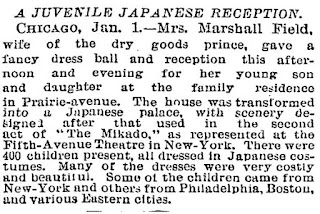 |
Copy of the original New York Times pieced
published January 1, 1886 |
Butlers, maids, nannies, and coachmen
The Dilemma of Charlotte Farrow tells the tale of a maid in service at the fictional Banning household, located just south of the Kimball mansion. The
Glessner House, at the corner of 18th and Prairie can be seen easily from the front door of the Banning home. The historical novel picks up where Book One,
The Pursuit of Lucy Banning, left off. With the backdrop of the 1893 World’s Fair and Chicago’s changing social order,
The Dilemma of Charlotte Farrow gives readers a glimpse into the opulent lives of the residents of Prairie Avenue. It also explores the lives of the butlers, maids, nannies, and coachmen who catered to their wealthy employers’ every whim to make them comfortable.
Secrets and Prairie Avenue’s social code
 |
| Book One in the Avenue of Dreams series |
But Charlotte Farrow has a real dilemma. How does she keep the fact that she has a small child a secret from her employers and the other staff members at the Banning household? Maids and live-in servants weren’t allowed to be married, let alone have children. Charlotte must navigate the social codes of the day, all the while providing the best for her young son—in secret.
Praise for
The Dilemma of Charlotte Farrow
“Newport’s latest novel, The Dilemma of Charlotte Farrow, provides an enthralling examination of the complex class and gender barriers in nineteenth-century Chicago.” Julie Cantrell, New York Times and USA Today bestselling author of Into the Free
“Set with exacting detail in Chicago during the World’s Columbian Exposition, Charlotte’s tale of courage and struggle will keep you on the edge of your seat from the first page to the last.” William Tyre, executive director and curator, Glessner House Museum
“Book two in Newport’s Avenue of Dreams series is a wonderful historical romance that has everything fans of this genre look forward to: romance, intrigue and secrets, as well as characters that are rich in detail but not over the top. Newport is a wonderful writer who expertly mixes fiction with some facts from actual places and events. She explains the way of the social classes in 1893 and how little freedom and few choices the working class had. This is a book to read over and over again; it will be a keeper.” RT Book Reviews
Praise for
The Pursuit of Lucy Banning
“With attention to historical detail and an artful sense of place, Olivia Newport gives readers a fascinating glimpse into the way the wealthy interpreted the 1893 World's Fair – and the roles of women in the world. The Pursuit of Lucy Banning is a compassionate coming-of-age romance with a spunky, determined heroine and a Happy Ever After that's satisfyingly sweet.” Serena Chase, USA Today, Happily Ever After blog
“In a new historical series, Avenue of Dreams, readers will head to the Chicago World’s Fair of 1893 where they will be treated to the grandeur and charm of the wealthy and the not-so-wealthy. In this story thick with secrets and lies, Newports’s characters are by turn charming, conniving, or trying to be true to themselves in spite of what society expects of them.” RT Book Reviews


