Showing posts with label Chicago Film Club. Show all posts

Friday, October 7, 2016

Halloween film series at Daystar Center starting October 8 with “The Ghost and Mrs. Muir”

The Chicago Film Club’s Halloween series begins with a screening of the classic The Ghost and Mrs. Muir (1947) Saturday October 8, 2016 at the Daystar Center, 1550 S. State St. All movies start at 6:45 p.m.

A haunted cottage by the sea
When a young widow Lucy Muir (Gene Tierney) rents a house by the sea, she finds that it’s haunted by the ghost of Captain Gregg (Rex Harrison), the home's original owner. The two clash at first, but come to an understanding that turns into friendship and eventually love. When a flesh-and-blood suitor (George Sanders) makes a play for Lucy, what will become of the captain? This beautifully filmed movie (Charles Lang’s black and white cinematography was Oscar nominated) gave Tierney the chance to play a woman of warmth and character, rather than the icy, aloof beauty she was too often cast as.

Gene Tierney as Lucy Muir and Rex Harrison as Captain Gregg in The Ghost and Mrs. Muir

Top-flight talent
Besides the cast, the film has quite the pedigree. The film score was composed by the legendary Bernard Herrmann (VertigoPsychoTaxi Driver). Charles Lang (SabrinaSome Like it Hot) was in charge of the black and white cinematography. Lang was nominated for 18 Academy Awards. Film editor Dorothy Spencer (StagecoachForeign Correspondent) worked with some of the best directors in Hollywood, including Alfred Hitchcock, John Ford, and Elia Kazan edited the film. Fred Sersen who was in charge of the photographic effects department at Twentieth Century-Fox created the film’s special effects. Sersen won two Academy Awards for Best Effects (Crash DiveThe Rains Came). Gene Tierney’s husband, Oleg Cassini, designed the actress’s costumes. Cassini dressed Jacqueline Kennedy when she was First Lady. And last, but not least, the director Joseph L. Mankiewicz. Makiewicz is most famous for writing and directing All About Eve (1950), but he also directed A Letter to Three Wives (1949), The Barefoot Contessa (1954), Guys and Dolls (1955), Cleopatra (1963), and Sleuth (1972).


Other movies scheduled below:

October 15—The Innocents (1961) starring Deborah Kerr
October 22—The Body Snatcher (1945) starring Boris Karloff  - CANCELED
October 29—Psycho (1960) starring Anthony Perkins, Vera Miles, John Gavin, and Janet Leigh

Have some Joe and Enjoy the Show!
Before the movie, grab a cup of coffee from Overflow Coffee Bar, located within the Daystar Center. You can bring food and beverages into the auditorium; we even have small tables set up next to some of the seats. General Admission: $5 Students and Senior Citizens: $3.

Join the Chicago Film club; join the discussion
Twice a month we screen classic films and have a brief discussion afterward. For more information, including how to join (it’s free), click here. The Venue 1550 is easily accessible by the CTA. Please visit Transit Chicago for more information on transportation options.


Stephen Reginald is a freelance writer and editor. He has worked at various positions within the publishing industry for over 25 years. Most recently he was executive editor for McGraw-Hill’s The Learning Group Division. A long-time amateur student of film, Reginald hosts “Chicago Film Club,” a monthly movie event held in the South Loop, for the past two years. Reginald has also taught several adult education film classes at Facets Film School, Chicago.


Daystar Center located at 1550 S. State St. works through a grassroots network of collaborations and partnerships with individuals and other nonprofit organizations. Through this web, they’re able to provide educational, cultural, and civic activities that enrich and empower their clients, guests, and community members. To learn more about classes and events offered at the Daystar Center, please visit their Web site.

Tuesday, September 8, 2015

Alfred Hitchcock's "The Wrong Man" screens at Daystar Center September 15, 2015

When: Tuesday, September 15, 2015 6:30 p.m.
Where: The Venue 1550 at the Daystar Center, 1550 S. State Street

In 1956, Director Alfred Hitchcock put suspense aside and crafted The Wrong Man based on real-life events. Henry Fonda plays musician Manny Balestrero who is wrongly accused of a series of armed robberies. Filmed in semi-documentary style, Hitchcock directs a very competent cast headed by Fonda and Vera Miles as his grief-stricken wife, Rose. One of the most unusual films in the director’s canon, it’s also one of his most impressive.

Have some Joe and Enjoy the Show!
Before the movie, grab a cup of coffee from Overflow Coffee Bar, located within the Daystar Center. You can bring food and beverages into the auditorium; we even have small tables set up next to some of the seats. General Admission: $5 Students and Senior Citizens: $3.

Join the Chicago Film club; join the discussion
Once a month we screen a classic film and have a brief discussion afterward. For more information, including how to join (it’s free), click here. To purchase your ticket in advance, click here. The Venue 1550 is easily accessible by the CTA. Please visit Transit Chicago for more information on transportation options.


Daystar Center located at 1550 S. State St. works through a grassroots network of collaborations and partnerships with individuals and other nonprofit organizations. Through this web, they’re able to provide educational, cultural, and civic activities that enrich and empower their clients, guests, and community members. To learn more about classes and events offered at the Daystar Center, please visit their Web site.

Monday, October 13, 2014

Hitchcock’s “Shadow of a Doubt” to screen October 14, 2014 at Daystar Center

When: Tuesday, October 14, 2014 6:30 p.m.
Where: The Venue 1550 at the Daystar Center, 1550 S. State Street

A Personal Favorite
Considered Alfred Hitchcock’s personal favorite of all his films, Shadow of a Doubt (1943), is also the only film he ever shot entirely on location. Hitchcock picked Santa Rosa, CA, because it exemplified, at least it did in 1942, the ideal American town. Film critic Bosley Crowther said in his review of the film, “The flavor and ‘feel’ of a small town has been beautifully impressed in this film by the simple expedient of shooting most of it in Santa Rosa, Calif.”

No Prima Donnas
One of the reasons Shadow of a Doubt was Hitchcock’s favorite was due to the cast. Teresa Wright and Joseph Cotton, although movie stars, weren’t prima donnas. The director was impressed with Wright’s professionalism and preparation for her role. Cotton thought Hitchcock was one of the easiest directors he ever worked with. The two hit it off from the start and remained great friends for the rest of their lives. The rest of the supporting cast, Henry Travers, Patricia Collinge, Hume Cronyn, and MacDonald Carey were all pros, with Cronyn, prior to this film, a stage actor, made his movie debut in Shadow of a Doubt. He too, along with his wife, Jessica Tandy (Tandy would  appear in The Birds some 20 years later.) remained friends with Hitchcock for the rest of his life.

Teresa Wright
Idolizing Uncle Charlie
When Uncle Charlie (Joseph Cotton) travels west to visit his sister and her family, the sleepy town of Santa Rosa is never the same. Handsome and debonair, Uncle Charlie is idolized by his young niece Charlene “Charlie” Newton (Teresa Wright) who has become disenchanted with her small-town life. Uncle Charlie represents glamour and excitement to young Charlie and she craves his attention.

Word of Mouth
As word spreads about a man they call the Merry Widow murderer, Charley suspects that he and her beloved uncle to be one in the same. But when a government agent investigating the case befriends her, Charley is faced with some tough choices. Does she cooperate, putting her uncle at risk, and upsetting her mother? By getting closer to her uncle, does she put her own life in jeopardy?

Where Evil Lurks
With the help of playwright Thorton Wilder (Our Town) and screenwriter Sally Benson (Meet Me in St. Louis), Hitchcock created a truly suspenseful film. Shadow of a Doubt demonstrates one of Hitchcock’s favorite themes: evil can lurk in the most unlikely and innocent of places…within our own towns or cities and in the midst our own families.

Joseph Cotton
Have some Joe and Enjoy the Show!
Before the movie, grab a cup of coffee from Overflow Coffee Bar, located within the Daystar Center. You can bring food and beverages into the auditorium; we even have small tables set up next to some of the seats.

Join the Chicago Film club; join the discussion
fans. Once a month we screen a classic film and have a brief discussion afterward. For more information, including how to join (it’s free), click here. To purchase your ticket in advance, click here. The Venue 1550 is easily accessible by the CTA. Please visit Transit Chicago for more information on transportation options.


Backstory: Teresa Wright was nominated for Academy Awards for her first three film roles. It’s a record that stands to this day. She won for her performance in Mrs. Miniver (Best Supporting Actress). Shadow of a Doubt was only her fourth film where she was top billed. Wright was a legitimate stage actress, understudying for Martha Scott who was the original Emily in Thornton Wilder’s Our Town. She originated the role of Mary Skinner in the Broadway production of Life With Father, the role Elizabeth Taylor played on the screen.

Saturday, July 5, 2014

Hitchcock’s Mr. and Mrs. Smith to screen July 8, 2014 at Daystar Center

When: Tuesday, July 8, 2014 6:30 p.m.
Where: The Venue 1550 at the Daystar Center, 1550 S. State Street

Yes, a Hitchcock Screwball Comedy
In 1940, Alfred Hitchcock’s third American film, Mr. and Mrs. Smith, was a screwball comedy. Yes, that’s right a screwball comedy. And it starred Carole Lombard, who had recently been proclaimed the “Screwball Girl” in a Life magazine profile. Few classic movie fans are familiar with this Hitchcock comedy, even though it was a critical and commercial hit, making its debut at New York’s Radio City Music Hall.

Typically screwball
The plot is typical for a screwball comedy. Ann (Lombard) and David (Robert Montgomery) Smith, discover that through a technicality their marriage isn’t legal. After David admits to his wife that if he had it to do all over again, he wouldn’t get married, Ann decides that she doesn’t want to be married either. What follows is a series of events in which each spouse tries to make the other jealous. Ann starts dating David’s law partner Jeff Custer (Gene Raymond) and David takes a room at his club and starts to hang out with a philandering Chuck Bensen (Jack Carson), which leads to some of the film’s funniest moments.

Carole Lombard and Alfred Hitchcock look at the script
His kind of actress
Alfred Hitchcock loved Carole Lombard. She was his type of actress: beautiful, smart, earthy, and blonde. The Hitchcock family rented Lombard’s house after she and Clark Gable were married in 1939. The Hitchcock’s and the Gable’s became fast friends and it was inevitable that the director and actress would work together. Unfortunately, Lombard would make one movie after Mr. and Mrs. Smith, dying tragically in a plane crash the next year, after a successful war bond drive during World War II.


Award-winning script writer
The script written by Oscar winner, Norman Krasna (Hands Across the TableBachelor MotherIt Started with EvePrincess O’Rourke) is quite good and Lombard and Montgomery have great on-screen chemistry and deliver good performances. Raymond is perfect as Montgomery’s strait-laced college chum and partner. The film is peppered with some great character actors like Carson, Lucile Watson, Charles Halton, Esther Dale, and Betty Compson.

Mr. and Mrs. Smith proved that Hitchcock, the master of suspense, could be successful in any genre he put his mind to.

Have some Joe and Enjoy the Show!
Before the movie, grab a cup of coffee from Overflow Coffee Bar, located within the Daystar Center. You can bring food and beverages into the auditorium; we even have small tables set up next to some of the seats.

Join the Chicago Film club, join the discussion
The Chicago Film Club is for classic movie fans. Once a month we screen a classic film and have a brief discussion afterward. For more information, including how to join (it’s free), click here. To purchase your ticket in advance, click here. The Venue 1550 is easily accessible by the CTA. Please visit Transit Chicago for more information on transportation options.

Lombard and Anne Shirley in Vigil in the Night

Backstory: Mr. and Mrs. Smith opened on February 20, 1941 at New York’s Radio City Music Hall. Hitchcock and Lombard had hoped to get Cary Grant to costar, but he was not available. Some Hitchcock critics say that Mr. and Mrs. Smith was a critical and financial flop. This is not true. Audiences were delighted to see Lombard in a comedy after starring in two heavy dramas (Vigil in Night and They Knew What They Wanted). Hitchcock’s first three American films were all solid commercial successes.

Saturday, May 10, 2014

“Rebecca” to launch “Hitchcock in the 40s” film series May 13, 2014

When: Tuesday, May 13, 2014 6:30 p.m.
Where: The Venue 1550 at the Daystar Center, 1550 S. State Street


Hitchcock comes to America
By the late 1930s, Alfred Hitchcock had established himself as a major film director in his native England. The 39 Steps and The Lady Vanishes, Hollywood came calling. Independent producer, David O. Selznick put Hitchcock under exclusive contract in 1939 and the director moved to Los Angeles with his family. Hitchcock cemented his place in movie history with his first American feature, Rebecca.
After the successes of the

The search for the second Mrs. De Winter
Rebecca was released in 1940, but was in production during 1939, the same year Selznick’s epic Gone With The Wind was released. Many actresses vied for the female lead. However the desire to find a “new star” didn’t turn into the crazy spectacle like the search for Scarlet O’Hara. Many established actresses auditioned for the role, including Margaret Sullivan, Loretta Young, and Scarlet herself, Vivian Leigh. A 16-year-old Anne Baxter tested for the lead, and tested well.

A David O. Selznick production
Although Hitchcock was the director, Selznick was in control of the production and the casting. Originally, he wanted Olivia De Havilland for the second Mrs. DeWinter. Unfortunately, she was contracted to star in another film, plus, when she found out her younger sister Joan Fontaine was under consideration for the role, she was reluctant to pursue it seriously.

Judith Anderson and Joan Fontaine
The lead roles are set
For the role of Maxim DeWinter, Selznick originally wanted Ronald Coleman, who turned it down. Second choice was William Powell, but he wanted too much money, $200,000 to be exact. Lawrence Olivier, hot off of his success in Wuthering Heights, agreed to play Maxim for $100,000. He had hoped to have Leigh, his lover in real life, as his costar, but Selznick never thought Leigh was right for the part. However, Selznick agreed to test her. It’s clear from those tests (which still exist) that Selznick’s instincts were correct. Both Hitchcock and Selznick were happy with casting Olivier, but they still needed to cast the second Mrs. DeWinter. After reviewing all the screen tests it came down to Fontaine and Baxter, with Fontaine finally snagging the role (At 16, Baxter was considered too young). The pivotal role of the menacing Mrs. Danvers went to Judith Anderson. George Saunders, Gladys Cooper, Nigel Bruce, Florence Bates, and Reginald Denny rounded out the supporting cast.

Hitchcock at the helm
Although Rebecca was directed by Hitchcock, Selznick’s influence is everywhere. The production is posh Rear Window). Even with Selznick’s micro-management, Hitchcock’s hand is clearly seen. The performances he elicits from Fontaine, in her first major role, and the way he captures Olivier’s dark side as Maxim are clearly the result of Hitchcock’s masterful direction. Many of the supporting cast, including Nigel Bruce, George Saunders, and Leo G. Carroll would appear in future Hitchcock films to great effectiveness.
and the crew used is all Selznick, including musician Franz Waxman (when Hitchcock had more control of his films, he would use Waxman to score

The main cast  in a pivotal scene 
Award-winning success
Alfred Hitchcock was brought to America with all the great fanfare a showman like David O. Selznick could muster. The pressure was on both Selznick, to reproduce the success of the colossal Gone With The Wind and Hitchcock, to live up to the publicity stoked by Selznick. Rebecca proved the hype wasn’t misplaced. The film was an enormous success both critically and financially. It would go on to receive 11 Academy Award nominations, winning for cinematography, black and white, and Best Picture of the Year. Hitchcock was nominated for Best Director, but lost out to John Ford for The Grapes of Wrath.

Have some Joe and Enjoy the Show!
Before the movie, grab a cup of coffee from Overflow Coffee Bar, located within the Daystar Center. You can bring food and beverages into the auditorium; we even have small tables set up next to some of the seats.

Join the Chicago Film club, join the discussion
The Chicago Film Club is for classic movie fans. Once a month we screen a classic film and have a brief discussion afterward. For more information, including how to join (it’s free), click here.To purchase your ticket in advance, click here. The Venue 1550 is easily accessible by the CTA. Please visit Transit Chicago for more information on transportation options.

Tuesday, April 1, 2014

“What’s Up Doc?” final film screened in screwball comedy series April 12, 2014

When: Saturday, April 12, 2014 4:00 p.m.
Where: The Venue 1550 at the Daystar Center, 1550 S. State Street

I can’t think of a better film to end our screwball comedy series than with What’s Up Doc? This modern comedy classic directed by Peter Bogdanovitch is a homage to the screwball comedies from the 1930s and 40s. It owes much of its plot and structure to Howard Hawks’s Bringing Up Baby, but it more than stands on its own merits.

Barbra Streisand and Ryan O’Neal, in their first screen pairing, play Judy Maxwell and Howard Bannister respectively. Judy is a free spirit and college dropout who seems to create trouble wherever she goes. Howard is a Ph.D. and musicologist from the Iowa Conservatory of Music, engaged to Eunice Burns (Madeline Kahn) who is a bit controlling, to put it mildly. The trouble all begins in San Francisco when four identical overnight bags get mixed up. Of course Judy and Howard’s bags are part of the mix up and their lives become entangled from there on in.

Streisand and O’Neal were at the top of their box office appeal in 1972, and Bogdanovitch exploits this. Like screwball comedies past, there are inside jokes, and allusions to other films, all with great good humor. Apart from the stars, Bogdanovitch assembled some of the best character actors available, including Kenneth Mars, Austin Pendleton, Sorrell Brooks, John Hillerman, Graham Jarvis, and Mabel Alberston to name a few. Kahn, in her movie debut, all but steals the picture. As the constantly unhinged Eunice Burns, Kahn is pitch-perfect. Annoying to both O’Neal and Streisand’s characters, she is never annoying to the audience. When I first saw the film in theaters, audiences howled with laughter every time Kahn was on the screen.

As a screwball comedy, What’s Up Doc? is so good that if released in the late 1930s or early 40s, audiences would have responded to it the way they did My Man Godfrey, The Awful Truth, and The Lady Eve.

Backstory: This was Peter Bogdanovich’s homage to the screwball comedies of the 1930s and 40s, as well as a tribute to directors Howard Hawks, Leo McCarey, and Preston Sturges.

Trivia: Madeline Kahn was nominated as Most Promising Newcomer, female by the Foreign Press Association (Golden Globes). The Writers Guild of American (WGA), USA awarded What’s Up Doc? Best Comedy Written for the Screen (Buck Henry, David Newman, Robert Benton). The film’s first 2 weekends broke the Radio City Music Hall house record that had stood since 1933.

Ryan O’Neal and Barbra Streisand talk under the table.

Have some Joe and Enjoy the Show!
Before the movie, grab a cup of coffee from Overflow Coffee Bar, located within the Daystar Center. You can bring food and beverages into the auditorium; we even have small tables set up next to some of the seats.

Join the Chicago Film club, join the discussion
The Chicago Film Club is for classic movie fans. Once a month we screen a classic film and have a brief discussion afterward. For more information, including how to join (it’s free), click here.To purchase your ticket in advance, click here. The Venue 1550 is easily accessible by the CTA. Please visit Transit Chicago for more information on transportation options.

Friday, March 7, 2014

“The Lady Eve” 5th film in Screwball Comedy series screened March 11, 2014

When: Tuesday, March 11, 2014 6:30 p.m.
Where: The Venue 1550 at the Daystar Center, 1550 S. State Street

The Lady Eve (1941) Father and daughter con artists (Charles Coburn and Barbara Stanwyck) travel on transatlantic cruise ships swindling rich passengers in card games. When the two spot a big fish Charles Poncefort Pike (Henry Fonda), heir to Pike Ale—“The ale that won for Yale”—they decide to take him for all he’s worth. But when the daughter falls in love with their mark, things get complicated and hilarious. Preston Sturges directed his first big-budget hit with with amazing results. A critical and financial success, the New York Times declared The Lady Eve the best picture of 1941, above Citizen Kane! Once you see this film you’ll understand why they came to that amazing conclusion.

This was Preston Sturges’s third film as both writer and director and his first big-budget production, with A-list movie stars. After the critical and financial successes of The Great McGinty and Christmas in July, both released in 1940, Paramount gave Sturges free rein to craft The Lady Eve. For his leads, Sturges got Stanwyck and Fonda. From all accounts, both stars enjoyed working with each other and with Sturges. Sturges wrote The Lady Eve with Stanwyck in mind after he saw her performance in Remember the Night the year before. Sturges was so impressed with her characterization in that film that he knew she would be ideal as Eve.

Fonda, who had four films in release in 1940, including The Grapes of Wrath, was happy to star in a comedy. As Charles Pike, Fonda showed his lighter side, being especially deft at physical comedy. Fonda’s numerous pratfalls are one of the film’s major delights. Bosley Crowther in theNew York Times said, “No one could possibly have suspected the dry and somewhat ponderous comic talent which is exhibited by Henry Fonda as the rich young man.” As Eve, Stanwyck is one part of a trio of card sharks mixing it up with rich swells, like Pike, traveling by ocean liner. Along with her father, “Colonel” Harrington (Charles Coburn) and their “butler” Gerald (Melvin Cooper), Eve sees Pike as an easy mark.


A publicity shot during the filming of The Lady Eve

The Lady Eve is filled with a host of great character actors, most of which became part of the “Sturges Stock Company.” This stock company included William Demarest, Eric Blore, and Robert Grieg. The latter two appeared in Sturges’s Sullivan’s Travels, also released in 1941.

When the movie was opened, Crowther, declared Sturges, “the most refreshing new force to hit the American motion pictures in the past five years.” He went on to say that a “more charming or distinguished gem of nonsense has not occurred since It Happened One Night.”

The Lady Eve is not only one of the best screwball comedies, but one of the best American films ever made.

Henry Fonda said Barbara Stanwyck was his favorite leading lady.

Backstory: Preston Sturges wrote the screenplay for Remember the Night with Carole Lombard in mind. He was disappointed that Paramount didn't secure her services, but when he saw Stanwyck in the lead, he was impressed. Stanwyck told Sturges that no one writes comedies for her. Sturges said he would write one for her; that screenplay was The Lady Eve.

Join the Chicago Film club, join the discussion
The Chicago Film Club is for classic movie fans. Once a month we screen a classic film and have a brief discussion afterward. For more information, including how to join (it’s free), click hereTickets are $5 general admission; $3 for students and seniors.To purchase your ticket in advance, click here. The Venue 1550 is easily accessible by the CTA. Please visit Transit Chicago for more information on transportation options.


Saturday, February 8, 2014

“Bringing Up Baby” 4th film in Screwball Comedy classic screened February 11, 2014

When: Tuesday, February 11, 2014 6:30 p.m.
Where: The Venue 1550 at the Daystar Center, 1550 S. State Street

Today Bringing Up Baby starring Katharine Hepburn and Cary Grant is considered a classic. In June 2000, the comedy classic came in at number 14 in the American Film Institute’s (AFI) 100 Years…100 Laughs list. Upon it’s initial release, it’s success was spotty. It played at New York’s Radio City Music Hall for only one week; it was quickly replaced by Jezebel starring Bette Davis. Reviews were mixed, with some of the harshest criticism coming from Frank S. Nugent of The New York Times. Nugent said “Miss Hepburn has a role which calls for her to be breathless, senseless, and terribly, terribly fatiguing. She succeeds, and we can be callous enough to hint it is not entirely a matter of performance.”

The tale of Susan Vance (Hepburn) and her infatuation with paleontologist, David Huxley (Grant) is one that is fast-moving, hilarious, and exhausting! The dialogue is snappy and spirited, as are the antics of Hepburn and Grant, who get to show off their talents for physical comedy. Director Howard Hawks initially considered Carole Lombard, but Hepburn was eventually given the female lead. The male lead was offered to Robert Montgomery, Fredric March and Ray Milland. They all turned it down. Grant having gained new-found fame after his star turn in The Awful Truth, was reluctant to play a scientist, but eventually used the opportunity to renegotiate his non-exclusive contract with RKO, the studio producing the film (Grant made more money than top-billed Hepburn).
Katharine Heburn, Skippy, and Cary Grant

Having had a run of several disappointing pictures, while under contract to RKO, Hepburn’s movie career was in decline. Before Bringing Up Baby’s release, Hepburn was declared box-office poison by the Independent Theatre Owners of America. After Baby’s release, Hepburn returned to the stage and wouldn’t make a movie for two whole years. Grant on the other hand was moving up in the world and was a fan favorite. In 1940, Hepburn triumphantly returned to the screen in The Philadelphia Story, costarring Grant and James Stewart.


Backstory: Besides leads, Hepburn and Grant, Baby is populated with a wonderful collection of character actors, including Charlie Ruggles, May Robson, Walter Catlett, and Barry Fitzgerald. And Skippy the dog, who had supporting roles in The Thin Man Movies and The Awful Truth, barks his way through another classic film.

Have some Joe and Enjoy the Show!
Before the movie, grab a cup of coffee from Overflow Coffee Bar, located within the Daystar Center. You can bring food and beverages into the auditorium; we even have small tables set up next to some of the seats.

Join the Chicago Film club, join the discussion
The Chicago Film Club is for classic movie fans. Once a month we screen a classic film and have a brief discussion afterward. For more information, including how to join (it’s free), click here.To purchase your ticket in advance, click here. The Venue 1550 is easily accessible by the CTA. Please visit Transit Chicago for more information on transportation options.

Sunday, January 5, 2014

The Chicago Film Club screens “The Awful Truth” January 14, 2014

Irene Dunne and Cary Grant in The Awful Truth
The Chicago Film Club will present The Awful Truth starring Irene Dunne and Cary Grant at The Venue 1550 at the Daystar Center, 1550 S. State St., January 14, 2014. Show time is 6:30 p.m., followed by a brief discussion.


In 1937, Irene Dunne was at the height of her career. The year before, Dunne received a Best Actress Academy Award nomination for Theodora Goes Wild, a comedy role she was reluctant to take. Not only was that picture a critical success for Dunne, but a huge box office hit for Columbia Pictures. So it wasn’t a surprise that the next picture she would make for the studio would be another comedy.

The Awful Truth open at Radio City Music Hall
in November 1937.
From Stage To Screen
The Awful Truth was based on a play by Arthur Richman and brought to the screen with the aid of screenwriter Vina Delmar and Theodora Goes Wild screenwriter, Sidney Buchman, who went uncredited. Teamed with Dunne for the first time was Cary Grant. Grant was quickly becoming a top leading man in Hollywood, but his pairing with Dunne was inspired and their on-screen chemistry delighted movie-going audiences. B.R. Crisler writing in his New York Times review said, “Miss Dunne and Mr. Grant, as the couple...have fun with their roles, and the pleasure seems to be shared, on the whole, by the [Radio City] Music Hall audience.”

What Is The Awful Truth?
The plot revolves around the marital woes of Lucy (Dunne) and Jerry (Grant) Warriner. Each becomes suspicious of the other, which eventually leads them to divorce court. After the divorce, Lucy and Jerry are consumed with foiling each other’s new romantic interests. Is the awful truth the fact that Lucy and Jerry are still in love?

Dunne and Grant go to court over their dog, Mr. Smith.
Get Me Out Of This Picture
Like Dunne in the previous year’s Theodora Goes Wild, Grant wasn’t too happy working on this film.
Director Leo McCarey’s working style didn’t sit well with Grant and he tried to get out of the movie, even going so far as requesting he swap roles with supporting player Ralph Bellamy! McCarey liked to get spontaneous performances out of his cast, which meant a lot of on-set improvising, which Grant found unsettling. Eventually things worked out for all concerned. Ironically, this is the movie that catapulted Grant to superstar status and is responsible for the Grant movie persona.

Comedy Triumph
For Dunne, The Awful Truth was a delightful experience. She loved working with both McCarey (who became a personal friend) and Grant. Professionally, it was another triumph. Once again, the critics raved about her and the film. And once again she was nominated for Best Actress by the Motion Picture Academy. If there was any doubt about Dunne’s comedy chops, they were all dispelled when the film was first released on October 21, 1937. Dunne and Grant would go on to star in two other popular films: the comedy My Favorite Wife (1940) and the melodrama Penny Serenade (1941).

Award Winner
The Awful Truth was nominated for six Academy Awards, including Best Picture, Best Director, Best Screenplay, and Best Supporting Actor. McCarey won the only Oscar for his direction.

Lasting Legacy
In 2000, the American Film Institute listed The Awful Truth at #68 on its list of 100 Years…100 Laughs. In 2002, the AFI listed it at #77 on the 100 Years…100 Passions list.

Backstory: Mr. Smith, the Warriner’s dog in The Awful Truth, was more famous as Asta, the pet of Nick and Nora Charles (William Powell and Myrna Loy) from The Thin Man movies. This talented pet’s real name was Skippy.

Come early and enjoy delicious food and beverages at Overflow Coffee Bar. Mention the Film Club and get 50% off a beverage with the purchase of any food item. Stay on top of all the Chicago Film Club screenings by joining their Meetup page. It’s free to join!


Daystar Center located at 1550 S. State St. works through a grassroots network of collaborations and partnerships with individuals and other nonprofit organizations. Through this web, they’re able to provide educational, cultural, and civic activities that enrich and empower their clients, guests, and community members. To learn more about classes and events offered at the Daystar Center, please visit their Web site.

Tuesday, December 31, 2013

Top Posts of 2013

Hard to believe another year has come and gone in the South Loop, but it has. What were some of the things on our minds during 2013? Following are the top-ten posts which reflect a small portion of what was of interest to our friends and neighbors. Here we go, starting with number 10 at the top.

Strikers at the Congress Hotel
10. Strike at Congress Hotel ends after ten years—It was hard for some of us to believe that this strike was over. It was practically a tourist attraction. As long as we’ve been in the South Loop there was a strike in front of the landmark hotel, but it ended in May of 2013.

9. The Burger Point Delivers—Food and restaurants are always popular topics for us in the South Loop. So when a neighborhood favorite announced that they would now deliver, it was big news. Hmm, I think I want “The Gobbler” delivered to my door right now!

8. Creepy or Art: “Borders” Sculpture Installation in Grant Park—This was a fun post. This art installation just south of the Art Institute had a lot of people talking. It reminded us of the 1950s science fiction classic  The Day The Earth Stood Still, but art is in the eyes of the beholder.

Creepy or art?
7. British School to delay opening—The British are coming! The British School that is. Somewhat of a controversy when announced, the British School will be building an opening a new campus at the Roosevelt Collection.

6. No neighborhood school for the South Loop—When the new campus for Jones College Prep was announced, many had hoped the older campus would become an open-enrollment neighborhood school. It was not meant to be.

5. Wabash Arts Corridor Crawl—Modern and contemporary art lovers found this event interesting and fun thanks to the participation of several local colleges and universities and neighborhood organizations in the South Loop.

4. Kai Sushi Opens Friday in the South Loop—Once again, a new restaurant opening got the attention of South Loop residents. Kai Sushi opened in July in the former Donna’s Café space.

3. A Walk Through Time on the “Sunny Street of the Sifted Few”—This annual fund raiser for the Glessner House Museum is a popular event and attacks crowds from all over Chicago and Illinois. It’s a once-a-year chance to peek inside some of the remaining mansions from the glory days of Prairie Avenue.

The Kimball House
2. “Mildred Pierce”: 4th Film in “High Heels and Fedoras” series at Daystar Center May 14, 2013—This popular film noir classic garnered a lot of attention. The Chicago Film Club features classic Hollywood movies viewed on the big screen with discussion afterwards.

1. South Loop Suicide Attempt Thwarted—It was hard to miss this event if you were commuting to work along S. Michigan Ave. on Friday, June 7, 2013. A man threatening to jump from 1250 S. Michigan Ave. caused road closures and traffic reroutes. South Loop Connection took some heat for covering this story, but it was news, with plenty of media on the scene. 

There were many stories from 2013 that didn’t make the top-ten here, but that doesn’t mean they were less important. What do you think were the top stories in the South Loop for 2013?

Monday, July 8, 2013

“Out of the Past”: 6th and Final Film in “High Heels and Fedoras” series at Daystar Center July 9, 2013

Tuesday, July 9, 2013
6:30 p.m.
The Venue 1550 at the Daystar Center
1550 S. State Street

Out of the Past (1947) is considered one of the best of the 1940s film noirs. In spite of the acclaim the film has received from critics, it’s not as well known as Double Indemnity (1944) or The Postman Always Rings Twice (1946), but it can easily hold its own next to those two classics.

Directed by Jacques Tourneur, Out of the Past showcases the director at the top of his game. Tourneur started out as a unit director working for David O. Selznick where he met fellow Selznick employee Val Lewton. Lewton worked on many of Selznick’s prestige productions including A Tale of Two Cities (1935) and Gone With The Wind (1939). The two became friends and when Lewton was put in charge of the newly formed horror unit at RKO, he convinced Tourneur to join him. Together they crafted some of the most famous and successful horror movies ever produced. Before the term film noir was coined, these horror films incorporated some of the elements that we have come to identify with the genre. In the three horror films Tourneur directed for Lewton, you see wonderful shadows, interesting camera angles, and creative use of sound to create a mood and stir the emotions.

Jane Greer and Robert Mitchum
Out of the Past gave Robert Mitchum one of his first important roles as a leading man. It also helped identify him as a movie tough guy, a reputation that would follow him for the rest of his career. This was also an important film for the leading lady, Jane Greer. Discovered by Howard Hughes, Greer was only 23 when the film was released. As femme fatales go, Greer is at the top of the heap. With her cool sensual beauty, it’s easy to see how she could handle a man like Mitchum.

Like many film noirs, a lot of the story is told in flashback. And like many noir plots, it does get complicated at times. Plot complexities aside, it’s the motivation of the characters that makes this film fascinating. The line between good and evil is a fine one in Out of the Past. As far as the direction goes, New York Times film critic Bosley Crowther noted Tourneur’s “smooth realistic style” in his November 26, 1947 review.

Jacques Tourneur directed the horror classic, Cat People 1942
The plot concerns Mitchum’s character Jeff Bailey, a former private eye trying to escape his questionable past. But the past catches up with him and he’s drawn back into a life he’d like to forget. Greer plays Kathie Moffet, a woman from Jeff’s past who is trying to break free of the clutches of her abusive boyfriend, Whit Sterling, convincingly played by Kirk Douglas in only his second film. Kathie, who earlier had an affair with Jeff, tries to manipulate him into helping her run away from Whit. Jeff, still attracted to Kathie allows himself to be manipulated, thinking he’s smart enough to come out okay. It’s this conceit that is his downfall.

Out of the Past features great performances paired with beautiful cinematography, snappy dialogue, and fluid direction. You’ll enjoy the ride; I guarantee it!

Check out the updated trailer below, featuring “Baby, Please Don’t Leave Me” by Chicago’s own, Buddy Guy.


If you love classic cinema, you should join the Chicago Film Club. It’s free to join. Come share your love of the movies; it’s fun!


The Daystar Center located at 1550 S. State St. works through a grassroots network of collaborations and partnerships with individuals and other nonprofit organizations. Through this web, they’re able to provide educational, cultural, and civic activities that enrich and empower their clients, guests, and community members. To learn more about classes and events offered at the Daystar Center, please visit their Web site.

Friday, April 26, 2013

“Mildred Pierce”: 4th Film in “High Heels and Fedoras” series at Daystar Center May 14, 2013


Tuesday, May 14, 2013
6:30 p.m.
The Venue 1550 at the Daystar Center
1550 S. State Street


Mildred Pierce was a critical and financial hit when released in 1945. It resurrected the career of screen legend, Joan Crawford, who many had written off as a has-been. The movie was a showcase for some new talent too, but it was Crawford’s film and she commands the screen in every scene she’s in.

The straightforward narrative in the James M. Cain novel was changed for the film version. Mildred’s story is told in flashback, a popular film noir convention that works really well and adds to the movie’s texture. The film itself is put together very nicely with the Warner Brothers A-Team pulling out all the stops. Cinematographer Ernest “Ernie” Haller’s black and white photography is beautifully atmospheric. The angles, the contrasts, are seamless and help advance the story without getting in the way. The score by Max Steiner is lush without being overwhelming, at least not overwhelming as far as Steiner scores go (They’re all kind of overwhelming, actually). Legendary makeup artist Perc Westore makes Crawford’s transition from waitress/working mom into successful/sophisticated businesswomen seem natural and believable. Much of Crawford’s look in this film, and for the rest of the decade, is due in great part to the costuming of Milo Anderson. Last but not least, director Michael Curtiz assembled all the pieces together to form a perfect whole, but Curtiz wasn’t at all set on working with Crawford.

Zachary Scott, Joan Crawford, and Ann Blyth

According to Crawford, Curtiz wanted Barbara Stanwyck to play Mildred. He didn’t want to work with a “difficult” has-been. In order to change Curtiz’s mind, Crawford submitted to a screen test. This was unheard of for an established star, but so determined was Crawford to snag the role that she consented. Crawford’s screen test impressed Curtiz enough that he agreed to direct her. And for Crawford, a new career was born at Warners.

Mildred Pierce was nominated for six Academy Awards, including Best Picture and Best Actress. Crawford’s Best Actress Award was the only win, but it propelled her back to the top of the heap, giving fellow Warner contract-player, Bette Davis a run for her money. Ironically, Davis’s career was on a downward arch while Crawford was starring in some critical and commercially successful melodramas. After Mildred Pierce, Crawford starred in Humoresque (1946), Possessed (1947), Daisy Kenyon (1947), and Flamingo Road (1949). Possessed brought her a second Best Actress nomination.

Mildred Pierce isn’t considered a true film noir movie, by some critics. But it sure feels like film noir to this movie fan.

To purchase tickets for the May 14 screening, click here. Tickets are $5 per person general admission $3 for students and seniors. Tickets may also be purchased at the door. To stay on top of film events like this, join the Chicago Film Club Meetup.


To download a flyer to post in your building or office, click here.


The Venue 1550 is located at 1550 S. State St. in the Daystar Center. The Daystar Center offers a variety of educational, artistic and cultural activities, including classes for children that teach practical life skills like social aptitude, creativity and cultural awareness in fun ways; classes for adults that give space for self-reflection and improvement; room rentals for many different-sized groups in several multipurpose rooms. For more information, call 312.674.0001 or visit their Web site.


Tuesday, April 2, 2013

Murder, My Sweet: 3rd Film in “High Heels and Fedoras” series at Daystar Center April 9, 2013


Tuesday, April 9, 2013
6:30 p.m.
The Venue 1550 at the Daystar Center
1550 S. State Street


Murder, My Sweet, based on the novel by Raymond Chandler, was released in 1944, a few months after another noir classic, Double Indemnity. It was popular with audiences and critics alike. It also transformed Dick Powell from a pretty-boy singer into a film noir icon. It also provided a great femme fatale role for Claire Trevor, one of Hollywood’s most versatile and talented actresses. For Anne Shirley, who was acting in the movies since she was four years old, her portrayal of Ann Grayle would mark her last film role.

Powell was probably the only actor in Hollywood who actively campaigned to play Walter Neff in Double Indemnity. Most of his contemporaries were afraid to play a murderer, but Powell was desperate to reinvent himself.

As a contract player at Warner Brothers, Powell was cast in musicals often costarring tap dancer Ruby Keeler and his first wife Joan Blondell. With his pretty-boy looks and tenor voice, Powell was a matinee idol during the early to mid-1930s. As the 1940s began, Powell thought he was too old to continue playing young romantic leads.


Powell  starred in movie musicals
during the 1930s.
Although he didn’t get the Walter Neff role, Powell did secure a contract with RKO where they were developing a B-movie based on Raymond Chandler’s detective novel, Farewell, My Lovely. When Powell and Trevor signed on as leads, the budget increased, turning it into an A-picture. Audiences and critics loved Powell’s portrayal of detective Philip Marlowe. Powell was now a successful dramatic actor. His reinvention was complete. Here’s what the New York Times said of Powell: “This is a new type of character for Mr. Powell. And while he may lack the steely coldness and cynicism of a Humphrey Bogart, Mr. Powell need not offer any apologies. He has definitely stepped out of the song-and-dance, pretty-boy league with this performance.”

Murder, My Sweet made Powell a bankable star once again. It also gave Trevor one of the best roles in her long movie career. For director, Edward Dmytryk, it raised his profile at RKO. He was given more A-movies to direct, including the Academy Award nominated Crossfire (1947). Dmytryk would go on to direct the epic Raintree County (1957), The Young Lions (1958), and the all-star The Carpetbaggers (1964), which was the highest grossing film that year.

To purchase tickets for the March 12 screening, click here. Tickets are $5 per person general admission and  Chicago Film Club. To download a flyer to post in your building or office, click here.

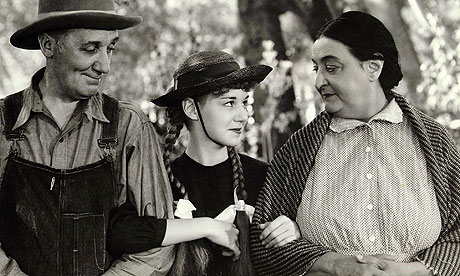
Anne Shirley (center) in Anne of Green Gables
$3 for students and seniors. Tickets may be purchased at the door. To stay on top of classic movie screenings in Chicago, join the

Backstory: Anne Shirley began acting in silent movies when she was only four years old. She started out as Dawn O’Day, but when she portrayed Lucy Maud Montgomery’s heroine Anne Shirley in Anne of Green Gables, she took that name for her own. Shirley progressed from child star to adult roles; she was one of many actresses who tested for the role of Melanie Hamilton in Gone With The Wind, eventually losing out to Olivia de Havilland.

She met and married her second husband, Adrian Scott, who produced Murder, My Sweet.

Related Posts Plugin for WordPress, Blogger...